Wholesale second hand clothing bales, boxes or mixed lots: which format?
By the Recycling Italy team
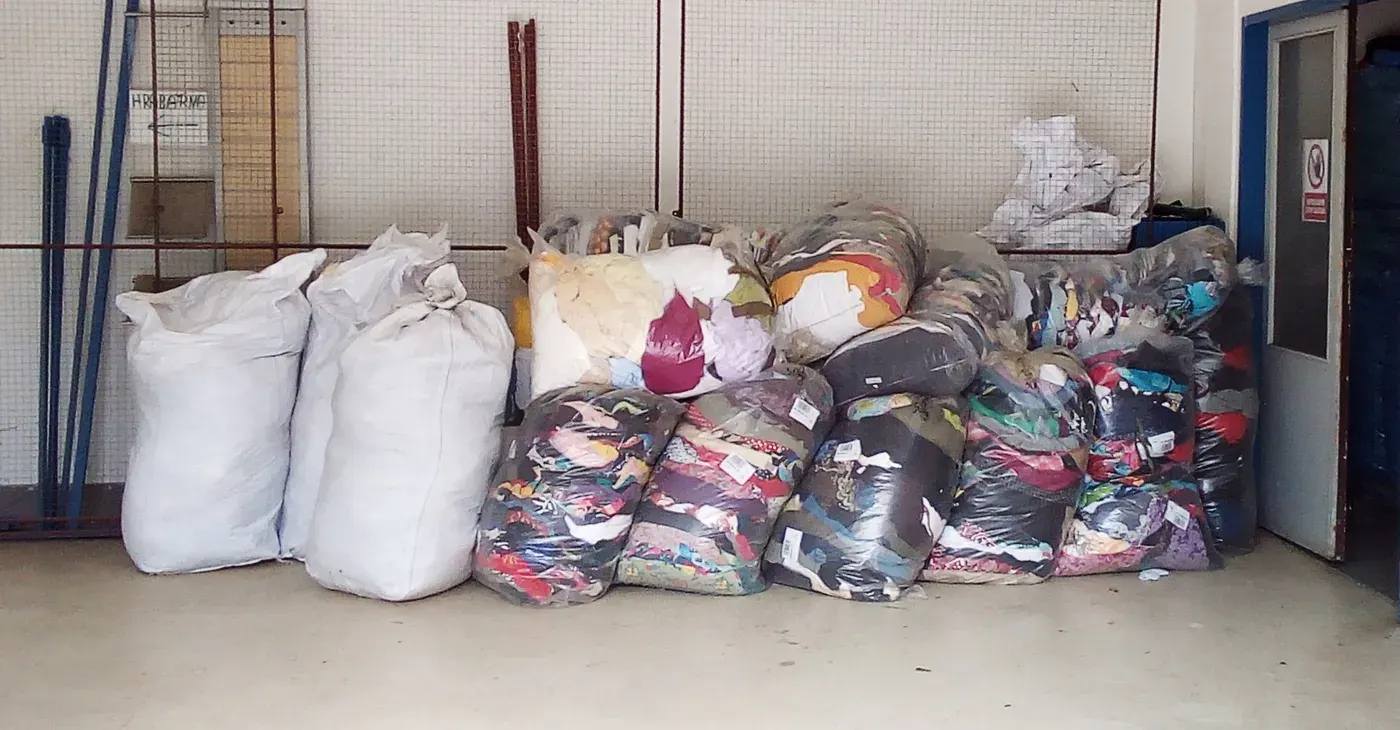
Wholesale second hand clothing bales, boxes and mixed lots differ in what they ask from you after the truck arrives. Bales are compact and need a pallet truck and floor space. Boxes are easier to carry and open one at a time. The format you choose should follow your room, your labour and your way of selling.
Four formats, in plain words
A bale is a block of garments pressed together and tied or wrapped, so that a large quantity takes little space. A box or carton holds fewer pieces and opens like any shop delivery. A sack is a soft bag that sits between the two: lighter than a bale and easier to move than a box of the same weight. A mixed lot combines several categories in one consignment, whatever the container.
These words are used loosely in the trade, so do not assume that your supplier and you picture the same thing. When you read an offer, look for the container type, the number of units and the weight of each. Packing formats second hand lots arrive in should be stated in the offer, and the description in the offer is what counts.
Why customs texts talk about bales and sacks
Packing also matters to customs. In the Harmonized System, as published in the UK Trade Tariff, note 3 to chapter 63 says that heading 6309 for worn clothing and other worn articles applies only to articles that show signs of appreciable wear and are "presented in bulk or in bales, sacks or similar packings". The note therefore ties the classification of a used lot to the way it is packed.
The same tariff has a separate heading, 6305, for "sacks and bags, of a kind used for the packing of goods". That heading covers the empty sack as a product in its own right, which is a different thing from its contents.
For a buyer the lesson is modest. The packing formats second hand lots come in are part of how the goods are described to customs, so keep the wording of the offer and the transport papers consistent.
Bales vs boxes used clothing buyers compare
Most buyers weigh bales vs boxes used clothing lots by how much handling they can afford. The table sets the formats side by side. It describes general behaviour, not the contents of any particular offer.
| Format | Handling | Storage | Sorting by the buyer | Road transport |
|---|---|---|---|---|
| Bale | Pallet truck or forklift, cutting the strapping to open | Compact, stacks well while sealed, takes up room once opened | One category per bale makes it quick, but a whole bale must be sorted at once | Dense load, few units to count, needs pallets or a flat floor |
| Box or carton | Carried by hand, opened one at a time | Bulkier, easy to shelve and relabel | Small increments, good for testing a category | More units to count, fits pallets in regular layers |
| Sack | Light to drag, awkward to stack | Needs a dry corner and cannot be piled high | Medium increments, mixed content likely | Fills gaps in a load, less stable than rigid cartons |
| Mixed lot | Depends on the container | Depends on the container | More variety, more sorting before the rail is ready | Same as the container it is packed in |
Buying by weight, checking by count
Lots are sold by weight, so the weight on the offer is the starting point of the price check, not an afterthought. Ask for the weight per unit as well as the total, and ask how many units make the order. A total that looks right but divides into units of very uneven size is a sign that the description is loose.
The consignment note helps here. Under the CMR Convention, the note has to state the number of packages and their marks, the gross weight of the goods or their quantity otherwise expressed, and the description of the nature of the goods and the method of packing. Check those lines against the offer before you sign for the lot, and keep a copy.
Handling and storage at your end
Whatever the format, used clothing needs a dry place off the floor. Wet or damp stock gets musty, and a musty smell can be hard to remove from a rail of garments. Pallets or racks under the units, a clear route to the sorting table and a light that lets you see colour are low-cost measures and worth having before the delivery.
Open one unit first and keep the rest sealed until you have judged it.
A bale cut open on a shelf that is too small becomes a heap in a corner, and a heap is how items get lost or creased. If you sort by category on the day of arrival, you also have a clean record of what was in each unit, which helps if you later need to explain a problem.
Check the pallet under the lot
Wooden pallets are part of the delivery. EPAL's sheet lists faults that make a Euro pallet non-exchangeable and in need of repair: a missing board, a block that is missing or split so that more than one nail shank shows, and a board broken across or diagonally. It also treats a pallet contaminated in a way that may spoil the payload as unfit.
Look at the pallet as the unit comes off the truck, because a failing pallet is a hazard for whoever stands beside it and a cause of crushed cartons. EPAL pallets carry markings, among them a plant-protection mark with the treatment method, heat treatment. Agree in advance whether the pallets stay with you or leave again with the carrier.
Pallets and loading on the road
Bales and cartons usually travel on pallets, and the Euro pallet is the common base. The product sheet of EPAL, the European Pallet Association, gives a footprint of 800 by 1,200 mm, a height of 144 mm, a weight of approx. 25 kg and a safe working load of 1,500 kg.
When laden pallets are stacked on a solid, even surface, EPAL says the bottom pallet must not carry more than 5,500 kg. Ask for the dimensions of each unit, so that you can see how many fit on a pallet before the truck is booked.
How a load is secured is a matter for the people who pack and load it.
The European Best Practice Guidelines on Cargo Securing for Road Transport (2014), prepared by an expert group of the European Commission, list among the first duties "a correct description of the cargo", including the mass of the load and of each load unit, its dimensions and any limits on stacking. They add that a contractual agreement on functional responsibilities is advisable.
One example in the guidelines concerns palletised consumer goods in packaging that is not rigid. Where lashings cannot be used, the walls of the vehicle can hold the load if each pallet load is a uniform block, gaps are closed with void fillers and the total gap across the width of the vehicle does not exceed 15 cm.
The guidelines also remind readers that the side walls of a curtainsider built to EN 12642 L count as weather protection only. A bale or carton that leans on a canvas wall is therefore not secured by it, and the question of who loads, who checks and who signs belongs in the written arrangements.
Documents that travel with the lot
When the goods cross a border by road, the CMR Convention applies if the place of taking over and the place designated for delivery are in two different countries and at least one of them is a contracting country. Under Article 5 the consignment note is made out in three originals, signed by the sender and the carrier. One copy is handed to the sender, one rides with the freight and one stays with the carrier.
On taking over the goods, the carrier must check the number of packages, their marks and numbers, and the apparent condition of the goods and their packaging. If the carrier writes no reservation, it is presumed that the goods and packaging looked in good condition.
Article 10 adds that the sender is liable to the carrier for damage and expense due to defective packing, unless the defect was apparent or known to the carrier and no reservation was made. Packing is therefore not a cosmetic detail: it decides who carries the cost when a unit bursts in transit.
There is a labelling side too. Regulation (EU) No 1007/2011 says that labels or markings may be replaced or supplemented by accompanying commercial documents when textile products are supplied to economic operators within the supply chain.
That rule concerns supplies within the trade. What your own shop must put on the shelf is a separate question, and the clothing catalog page shows the groups a lot can be named by.
Wholesale second hand clothing bales or boxes: who needs which
A small shop with a back room and no forklift usually does better with boxes or small sacks. The units are easy to carry, one carton can be opened and tested without committing to a whole lot, and shelving them takes no machinery. The cost is more units to count and to store.
A larger reseller with a loading bay, a pallet truck and a sorting team can take bales and handle the volume with fewer movements. The deciding point is not size alone but what you do with the goods: if you resell onwards in smaller portions, a bale gives you the quantity to divide, while a shop that sells directly to customers needs finer increments.
Market stalls sit in between. They often favour a handful of cartons that fit a van, because the stock must be loaded, unloaded and put out each week. Be realistic about your vehicle and your helpers, and choose the unit that two people can move safely.
A routine for opening the first unit
The first unit tells you more than the offer can. Treat it as a test and write the result down.
- Weigh the unit and compare it with the weight on the offer and on the consignment note.
- Photograph the packaging before you cut anything, including any damage you can see.
- Cut the strapping carefully, away from the garments, and empty the unit onto a clean table.
- Make three piles: ready for the rail, needs cleaning or a small repair, and not usable.
- Count each pile and note the categories and sizes you find.
- Compare the piles with the offer and keep the notes with the photographs.
If the first unit is typical, the same routine on the next one is faster. If it is not, you have the evidence for a timely conversation with the supplier, and the article on the sorting grades helps you name what differs.
Reading the description of a mixed lot
A mixed lot is a consignment of several categories, and the word "mixed" alone says nothing about proportions. Ask the supplier to name the categories, the sizes and the tier in the offer, and to say whether known brands may appear. Known brands can show up in mixed lots, but nothing promises them, so do not budget for them.
Photographs and descriptions are indicative, and each lot differs in weight, condition and style. Ask to see photos or a short video of your lot before you confirm, and compare what you see with the written offer. If something differs, say so before the order is final, not after the goods are on your floor.
Questions to put in the enquiry
- Which container types are available for the category you want, and how many units make up the order?
- What is the weight of each unit and what is the total weight?
- Are the units sorted by category, by tier, or mixed?
- Will the goods travel on pallets, and what are the dimensions of each unit?
- Which papers will accompany the goods, and in what language?
Send these questions with a short description of your shop or stall through the contact form. The guide to buying wholesale and the page on stock clothing cover what happens before and after the format is chosen.
Frequently asked questions
Can I order one bale or one box to test a category?
Ask for it in the enquiry. How many units an order must contain depends on the product type and is confirmed in the offer. A small first order is a normal way to test a category before you commit to a larger lot.
Does the weight on the offer include the packing?
Ask the supplier to say it in writing. A CMR consignment note lists the gross weight of the goods, so the figure on the transport paper may differ from the net weight of the clothing. Compare the offer, the note and your own scale at delivery.
How should I store bales before I sort them?
Keep them dry and off the floor, on pallets or racks, with room around the unit you plan to open. Open one unit first and leave the others sealed until you have judged the content. Damp conditions spoil used clothing quickly.
Must a lot of used clothing travel on pallets?
Not always, and the offer should say how the goods are packed. When pallets are used, the Euro pallet is the common base, with a footprint of 800 by 1,200 mm according to EPAL. Ask for the dimensions of each unit so you can plan unloading.
Is a mixed lot harder to sort than a single-category bale?
Usually yes, because you spend more time separating categories and sizes before the rail is ready. A mixed lot suits a buyer who wants variety and has the hands to sort it. A single-category unit suits a buyer who wants speed.
What does the consignment note say about packing?
Under the CMR Convention, the note states the number of packages and their marks, the gross weight and the nature of the goods and the method of packing. If the carrier writes no reservation, the goods and packaging are presumed to have been in good condition when taken over.